
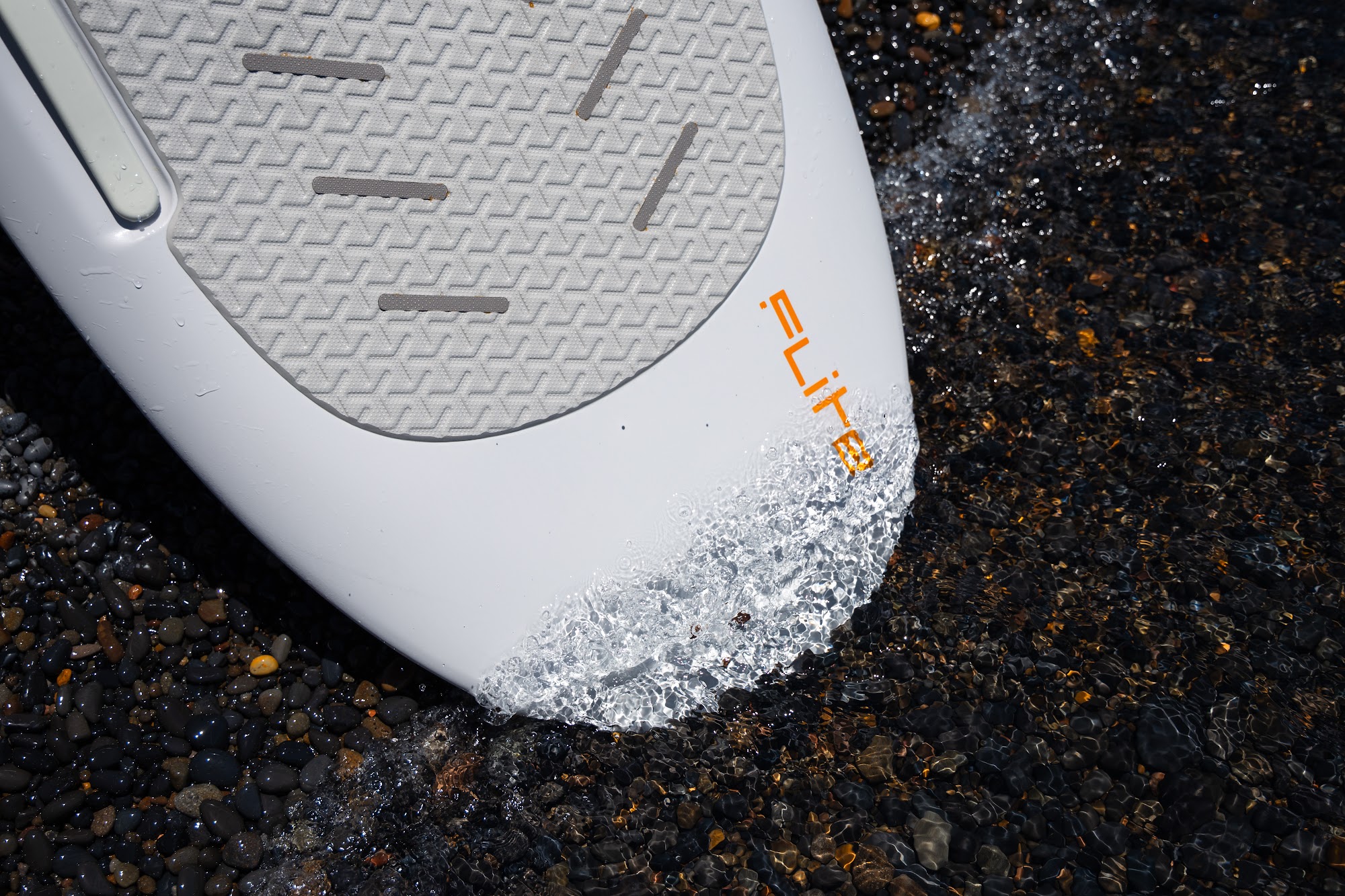
A complete Fliteboard setup starts around $11,000. Renting one on Lake Tahoe runs $365-$475 per board per day. Here is the real math, including the numbers most comparisons leave out.
By [[YOUR NAME]], owner and certified Fliteboard service technician, Efoil Tahoe. Certified Fliteboard dealer and Fliteschool on Lake Tahoe. 100+ five-star Google reviews. Updated August 2026.
The short answer
- A complete Fliteboard setup runs $11,000-$16,000 depending on board, wing set, battery and charger.
- Renting on Lake Tahoe is $475 for one day, dropping to $365 per day on a seven-day booking.
- Once you account for resale value, buying starts to win at roughly 5-6 days on the water per season if you keep the board about four years, and that counts every rider who uses it, not just you.
Renting vs. buying at a glance
| Consideration | Renting | Buying |
|---|---|---|
| What you pay | $365-$475 per board per day | $11,000-$16,000 up front |
| Board and foil | Matched to you, changeable day to day | One configuration you choose |
| Wetsuit and safety gear | Included | Bought separately |
| Delivery | Included anywhere on the lake on 2+ day rentals | You handle transport every session |
| Time to water | Arrives assembled and charged | 20-30 minutes of setup and teardown |
| Maintenance | Ours | Yours |
| If something fails | We hand you another board | Service turnaround, or ship it out |
| Storage | Nothing to store | Dry board space plus a temperature-controlled spot for the battery |
| Availability | Needs a reservation | Ride the moment the lake goes glassy |
| Sharing it | Take turns through the booking, splitting the cost | Partner, kids and friends ride it all season |
| Money back at the end | None | Used Fliteboards hold value well |
| Best fit | Tahoe trips and occasional riding | Frequent riding across several seasons |
What a Fliteboard actually costs
Fliteboard prices its boards as complete configurations rather than a base price plus extras. Three real builds, from the entry point to the top of the range:
| Configuration | Setup | Price |
|---|---|---|
| ICON Fiberglass - beginner to intermediate | Jet C 80cm eFoil, Flitecell Nano, slow charger | $10,999 |
| PRO Carbon - intermediate to advanced | Jet C 80cm eFoil, Flitecell Sport, fast charger | $14,099 |
| RACE x Mercury Racing Carbon - the fast one | Flux 707 wing set, Flitecell Sport, fast charger | $15,895 |
Prices exclude shipping and tax, and change with configuration and model year. The ULTRA L3 sits alongside these for riders chasing the lightest possible board. Confirm current pricing before you order.
The two decisions that move the price most are the board material and the battery. Fiberglass is heavier and less expensive than carbon and takes knocks better. On batteries, the Nano is 13.7 lbs and rated up to 45 minutes of foil time, the Sport is 23.4 lbs and up to 90 minutes, and the Explore is 32 lbs and up to 150 minutes. Most Tahoe riders land on a Sport.
What owning one actually costs over a season
Fliteboard covers the whole product line with a two-year warranty, and the boards are engineered to a standard that shows up in how they age. Ownership still carries running costs, though, and they rarely appear in a price comparison.
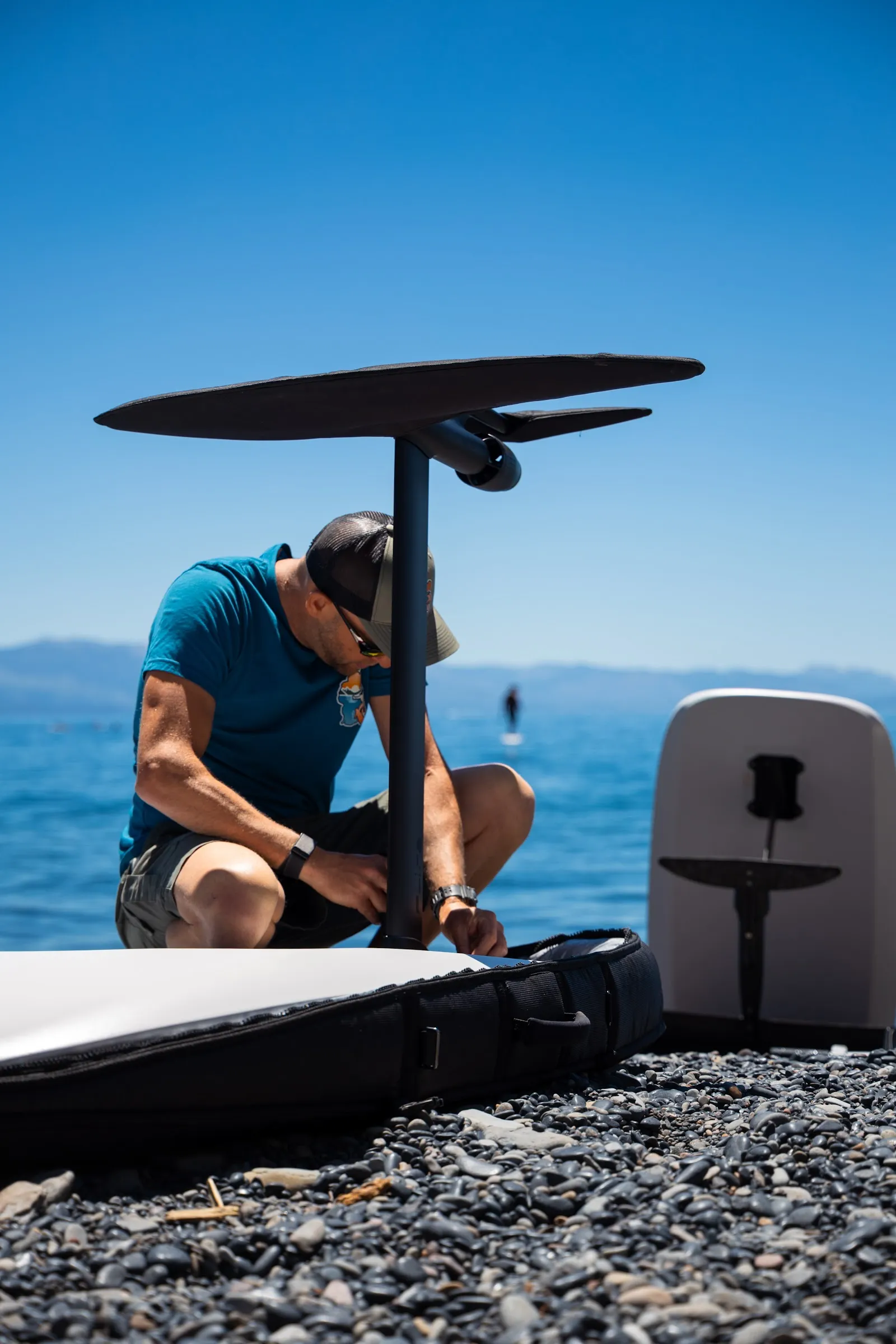
The battery. A replacement Flitecell Sport is $2,860 and an Explore is $3,960. The good news is that you are unlikely to need one soon. Flitecells are commonly rated for 700-1,000 charge cycles, and we have seen well past 800 with no meaningful capacity loss. At 20 sessions a year, cycle count is not what retires a battery. Calendar age is. Budget for a replacement somewhere around year six to eight rather than treating it as an annual line item.
What does matter is where it sleeps. Every lithium pack wants to be stored partly charged and at a moderate temperature, and a Flitecell is no exception: near 40% charge, somewhere dry between 50 and 77 degrees F, topped to about 60% every couple of months. The titanium Flitecell's self-balancing system handles the rest on its own, and the Flite app lets you charge to an exact state of charge, which makes this genuinely easy, as long as you have somewhere that is not an unheated Truckee garage in January. We wrote a full guide to winter storage for boards and batteries if you want the details.
Wear and repair. This is where Fliteboards keep surprising us. Our fleet does perhaps ten times the mileage of a private board and the consumables list is still short. We service boards that are five years old and still ride like new, and one rider we know has put 250 hours on his in under two years with a board that still looks close to showroom. Damage comes from contact rather than use: touching down on rocks scratches wings, and rushed assembly is hard on threads and seals. Carbon repairs well, which is why almost none of these boards are ever written off.
Insurance. Worth a conversation with your carrier. A $13,000 board is not obviously covered by a standard homeowner's policy, and most private owners we talk to have never checked.
What a private owner should budget per season:
| Item | Typical annual cost |
|---|---|
| Wings, props, hardware and consumables | $150-$400 |
| Annual service and winterization | $250-$400 |
| Battery replacement, spread over 6-8 years | $350-$475 |
| Insurance, if you carry it | Varies, ask your carrier |
| Reasonable planning figure | $600-$1,000 per season |
We handle maintenance and repairs locally, so none of this requires shipping your board across the country.
What three seasons of fleet data actually shows
Most buying guides are written by people who have owned one board. Ours comes off a rental and lesson fleet: 1,647 sessions, 10,388 miles and 1,156 hours of flight time logged through the Flite app, on the busiest Fliteschool in the world through July and August 2026. A few things that data settles:
Altitude does nothing. This comes up constantly, because a jet ski genuinely does lose power at 6,225 feet. An eFoil has no air intake and no combustion, so the motor does not care. The only thing that notices the elevation is the rider.
Cold water barely moves range. General guidance, including Fliteboard's own, is that colder conditions shorten ride time. On Tahoe, where surface temperatures swing from around 42 degrees F in winter to roughly 70 in August, we have not measured a difference worth planning around. A Sport cell covers a full hour-long lesson every time. We swapped a battery mid-session twice all season, both for riders over 275 lbs, which lines up with Fliteboard's 265 lb warranty limit on most setups. Rider weight is the variable that matters. Water temperature is not.
These boards are reliable. We regularly run five or six at once for group sessions and take around ten first-timers through a day. The fleet has run clean all season. That matters twice over: it should reassure you before you spend $13,000, and it should stop you assuming a rental will let you down.
It is also the argument for buying at the premium end rather than saving a few thousand. Cheaper eFoils exist, and so do the stories that follow them: a mast that fails, a battery that quietly dies, and a manufacturer who has gone quiet, leaving you with a board nobody can get parts for. A brand with a real dealer and service network behind it is the difference between a repair and a write-off.
What an Efoil Tahoe rental includes
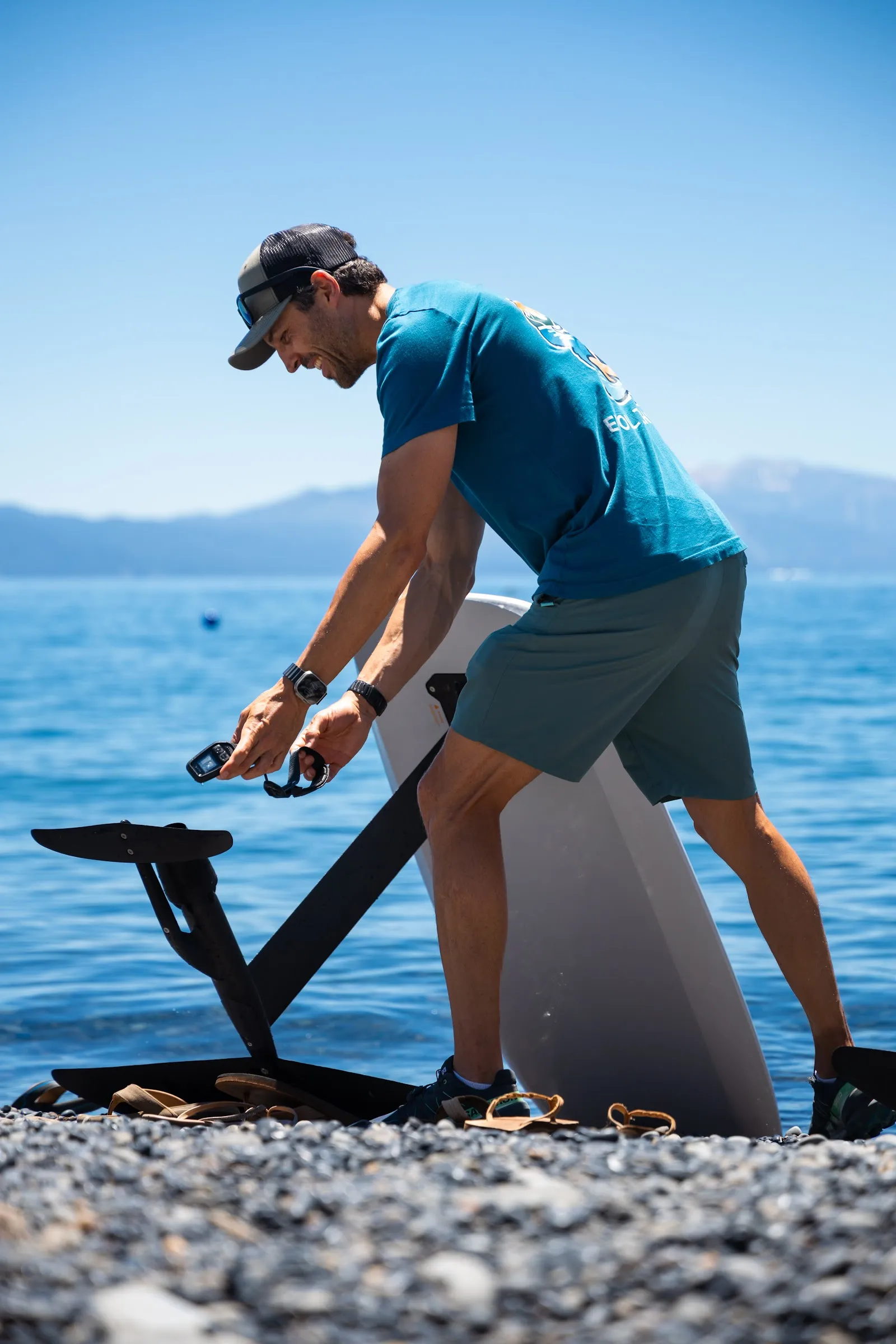
Every rental includes a Fliteboard ICON or PRO matched to the rider, one Flitecell Sport, a fast charger that turns the battery around in about an hour once it has cooled, a wetsuit, helmet and lifejacket, and a full briefing at handoff.
On rentals of two days or more, we deliver and collect anywhere around Lake Tahoe. The board arrives assembled, we size the gear to you, and we walk through charging and battery swaps before we leave. For most people that single detail is the difference between riding four times during a trip and riding once.
These are 2026 peak-season rates, June 19 through September 7, per board:
| Rental length | Daily rate | Total | Discount |
|---|---|---|---|
| 1 day | $475 | $475 | - |
| 2 days | $455 | $910 | 4% |
| 3 days | $435 | $1,305 | 8% |
| 4 days | $415 | $1,660 | 13% |
| 5 days | $395 | $1,975 | 17% |
| 6 days | $380 | $2,280 | 20% |
| 7 days | $365 | $2,555 | 23% |
Shoulder-season rates run lower, roughly $335-$445 per board per day depending on length. You can add a second Sport battery or an Explore for $100 per day, or step up to an ULTRA L3 or RACE setup for $200 per day. Extra gear sets are $20 per day if you are sharing a board.
Worth a moment of context, because $475 a day sounds like a lot until you price the alternatives. A full day on a jet ski in Lake Tahoe runs roughly $400 to $800 depending on the operator, on a machine that costs a third of what an eFoil does. eFoil rentals elsewhere in the West span $250 a day for peer-to-peer listings on budget brands up to $1,295 a day from premium operators. We sit in the middle of that range, on a premium board, with delivery included.
One distinction: an unaccompanied rental is for someone who already eFoils. If you have never ridden, start with a lesson. It is 90 minutes and nearly everyone is flying by the end. Our eFoiling 101 guide for first-timers covers what to expect. Riders who learned elsewhere may be asked to complete a short assessment before taking equipment out independently.
The real breakeven: cost per riding day
Most comparisons ask how many rental days it takes to add up to the purchase price. That question is wrong, because it quietly assumes the board becomes worthless. It does not.
The honest question is what each day on the water costs you. For an owner, that is the purchase price, minus what the board is worth when you sell it, plus upkeep, divided by every day the board gets used, by anyone.
Take a $12,000 setup kept for four seasons, sold at roughly half its price, with $800 a season in upkeep. Net cost: about $8,400.
| If the board is used | Total days over 4 seasons | Cost per day on the water |
|---|---|---|
| 5 days a season | 20 | $420 |
| 10 days a season | 40 | $210 |
| 20 days a season | 80 | $105 |
Renting the same board is $435 a day on a long weekend. So the crossover lands at roughly five to six days a season, far earlier than the 25-to-40-total-days figure you will see quoted elsewhere, because that figure ignores resale.
Run your own numbers:
[EMBED: buy vs. rent calculator goes here]
Almost nobody rides alone
This is the part most comparisons miss. On multi-day bookings, our customers are nearly always sharing the board with a partner, their kids or a group of friends, taking turns through the day. The same happens with boards people own.
For a single trip, sharing does not change the buy-versus-rent question. Three friends splitting a five-day rental still use five board-days either way. What it does change is the per-person price. A seven-day rental split three ways is about $850 each for a week of riding, which is a very different number from $2,555.
Over several seasons it tilts the other way, and hard. The variable that drives the breakeven is how many days the board gets used, not how many days you ride. If three people in a household each ride four days a summer, that is twelve board-days a season, comfortably past the crossover. A board you own gets used by a spouse, the kids and visiting friends all summer long. A rental gets booked for one trip. That difference compounds faster than the purchase price does.
Two honest caveats. If the board only sees three days a season, renting wins clearly, and you skip storage and transport entirely. And this is all cash math. It says nothing about the best reason to own a board, which is being able to ride the moment the lake goes glassy at 6am without making a reservation.
What used Fliteboards actually sell for
This is the number that makes or breaks the comparison, and almost nobody publishes it.
On the open market, complete used Fliteboard setups are commonly listed in the $6,500-$9,000 range, with newer and lower-hour boards near the top of it. A well-cared-for board still holds around 80% of its value after its first year. Our own fleet boards sell at the end of September at roughly 25-30% off, and they go quickly.
That resale strength is not an accident, and it is the quiet reason the ownership math works. Fliteboards hold value because the brand holds value: the boards last, parts are available, and there is a service network behind them. Boards from brands that have folded do not enjoy any of that.
Two warnings. Those are asking prices, not confirmed sale prices, so treat them as a ceiling. And condition drives everything: a board with clean wings, a healthy battery and a service history sells for real money, while one that has been dragged over rocks and stored badly does not.
Rules on Lake Tahoe: what an owner needs before launching
Because an eFoil has a motor, Tahoe treats it as motorized watercraft for invasive-species purposes. Every hand-launched electric watercraft, eFoils included, must be inspected at a TRPA station at least once each calendar year and display a Tahoe Electric sticker. The inspection and the sticker are free.
Beyond that, you are looking at vessel registration on your side of the state line: the Nevada Department of Wildlife in Nevada, the DMV in California, plus Nevada's own AIS decal if you are Nevada-registered. As a renter, none of this is your problem. Our boards are already inspected and stickered.
[[LINK TO THE STANDALONE REGISTRATION POST ONCE PUBLISHED]]
On the water, the etiquette is simple. Move slowly through swim areas, then keep well clear of swimmers and boats. We are not aware of any Tahoe beach that bans eFoils outright. The friction comes from riding fast near people, not from the boards themselves.
So which one fits you?
Rent if you are visiting for a few days, ride occasionally, or do not want to think about transport and winter storage. Rent also if you are still working out what you like. A week on an ICON teaches you more than any spec sheet, and you will learn whether you want a bigger, steadier board or the quicker response of a PRO.
Buy if you expect five or more riding days a season for several years, and you have water access, dry storage and a vehicle that makes it easy. Our wing selector tool is a good place to start narrowing the configuration.
The middle path, made concrete
Two things make trying before buying genuinely cheap:
- A $100 demo. Twenty to thirty minutes on the exact board you are considering. Fully credited toward your purchase.
- Rent-to-own credit. We apply 50% of what you spend on rentals toward a board purchase, up to $1,000, within the same season.
Rent for four days, decide you want your own board, and $760 of that comes straight off the price. There is no reason to guess.
Frequently asked questions
How much does it cost to rent an eFoil on Lake Tahoe?
Efoil Tahoe rentals run $365 to $475 per board per day during the 2026 peak season. One day is $475; seven days is $2,555, which works out to $365 per day. Delivery and pickup anywhere on the lake are included on rentals of two days or more.
How much does a Fliteboard cost?
Complete Fliteboard setups start at $10,999 for an ICON Fiberglass with a Nano battery and run to about $15,895 for a RACE x Mercury Racing carbon build, before shipping and tax. A PRO Carbon with a Sport battery and fast charger is $14,099.
When is buying an eFoil cheaper than renting?
Once resale value is included, buying pulls ahead at roughly five to six riding days per season if you keep the board about four years. A $12,000 setup sold at half price after four seasons costs about $210 per riding day at ten days a season, against $435 to rent.
How long does a Fliteboard battery last?
A Flitecell Sport delivers up to 90 minutes of foil time and reliably covers a full hour-long session. Over its life, Flitecells are generally rated for 700 to 1,000 charge cycles. At typical recreational use, calendar age retires a battery long before cycle count does.
Does altitude affect an eFoil at Lake Tahoe?
No. At 6,225 feet a combustion engine loses power, but an eFoil's electric motor has no air intake and performs identically to sea level. Only the rider notices the elevation.
Does cold water reduce eFoil range on Lake Tahoe?
Not meaningfully, in our experience. Across three seasons and more than 1,100 hours of flight time, in water ranging from about 42 degrees F in winter to 70 in August, we have not seen cold water shorten sessions in a way worth planning around. Rider weight has a far bigger effect.
Do you need a permit or registration to eFoil on Lake Tahoe?
Owners do. Every hand-launched electric watercraft, eFoils included, must be inspected at a TRPA station once per calendar year and display a Tahoe Electric sticker, both free. Vessel registration is handled through the Nevada Department of Wildlife or the California DMV depending on your side of the lake. Rental customers do not need to do anything; our boards are already compliant.
Can a beginner rent an eFoil without taking a lesson?
New riders should start with a lesson. Independent rentals are for riders who can already control the board, turn, stop and fall safely. If you learned elsewhere, a short assessment is usually all it takes.
Can several people share one eFoil rental?
Yes, and most multi-day customers do. Riders take turns through the day, so a seven-day rental split between three people works out around $850 each. Sharing does not change the daily rate. It changes what each person pays.
What do used Fliteboards sell for?
Complete used setups are commonly listed between $6,500 and $9,000, and a well-maintained board holds roughly 80% of its value through its first year. Condition, battery health and service history drive the price more than age does.
Should I buy from a local dealer or order online?
Buying locally means help choosing the configuration, correct assembly and pairing, and someone nearby when it needs service. Efoil Tahoe is a certified Fliteboard dealer and service center on Lake Tahoe, so the person who helps you configure the board is the person who supports it afterward.
Want a Fliteboard at your Tahoe place for a few days? Check availability
Thinking about buying? Message us and we will walk through configurations based on your size, experience and the kind of riding you want to do, and get you on the board first.


